Acetyl-L-Carnitine has been shown to provide a statistically significant and clinically meaningful reduction in depression compared to placebo and conventional antidepressants.1


Findings from a 2018 systematic review and meta analysis reveals the following:
- Combined results from nine randomised controlled studies show Acetyl-L-Carnitine significantly reduces depressive symptoms compared to controls;
- Combined results from three randomised controlled studies show Acetyl-L-Carnitine has a comparable effect to conventional antidepressants (fluoxetine, duloxetine, amilsulpiride) in treating symptoms of depression;
- Acetyl-L-Carnitine has 79% fewer side effects than conventional antidepressants.1
How much do I need?
According the research, the following dosages are recommended to achieve the desired results:
- 1 – 4 grams for reduction of depressive symptoms (a majority of studies used 3 grams);
- 1 – 2 grams for comparable effect to conventional antidepressants.1
How long does it take to work?
- Research indicates rapid and long lasting improvements.2 This is particularly exciting, as antidepressants require at least 2-3 weeks to significantly improve mood.3
- Results are generally achieved from 1 month to 3 months, depending upon the person and other lifestyle factors.1
How Acetyl-L-Carnitine works for depression
According to the research, Acetyl-L-Carnitine is said to:
- Promote neuroplasticity effects in cerebral regions such as the hippocampus.1
- Increase brain-derived neurotrophic factor (BDNF).1
- Increase glutamate release and counters glutamate-induced excitotoxicity.4,5
- Increase the up-regulation of mGLU2 receptors in the hippocampus and pre-frontal cortex areas of the brain.6
- Increase myo-inositol.7
- Play an important role in the modulation of neurotransmitters.6,7
- Increase serotonin levels in cerebral cortex and reduced serotonin turnover.1
- Enhance dopamine and serotonin output.1
- Protect against acute stress exposure.5
Can I get sufficient Acetyl-L-Carnitine through diet?
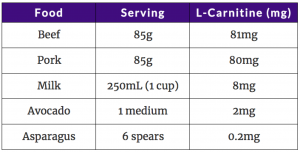
Meat, poultry, fish and dairy products are the richest sources of L-Carnitine. Fruit, vegetables and grains contain small amounts.8
Therapeutic doses of the acetylated form of L-Carnitine (Acetyl-L-Carnitine) may be difficult to achieve from foods. In the body, L-carnitine can convert to Acetyl-L-Carnitine , however it is the acetylated form (the addition of an acetyl group which occurs in a lab), that is used in these clinical studies, crosses the blood brain barrier more effectively and shows the promising results in depression.
Disclaimer: This information is designed as a guide only. As with all information listed on MindfulMoo.com, we recommend consulting your GP or medical practitioner before making any changes to your diet or lifestyle.
First published 14 Oct 2018
Reviewed/updated 24 Mar 2019
References & further resources
- Veronese N, National I, Stubbs B, Solmi M, Ajnakina O. Acetyl-L-Carnitine Supplementation and the Treatment of Depressive Symptoms: A Systematic Review and Meta-Analysis. Psychosom Med. 2018;80(2):154-159. doi:10.1097/PSY.0000000000000537.
- Nasca C, Bigio B, Lee F, et al. Acetyl-l-carnitine deficiency in patients with major depressive disorder. PNAS. 2018;115(34):8627-8632.
- Nasca C, Xenos D, Barone Y, Caruso A, Scaccianoce S, Matrisciano F. causes rapid antidepressant effects through the epigenetic induction of mGlu2 receptors L -acetylcarnitine. PNAS. 2013;110(12):4804-4809. doi:10.1073/pnas.1216100110/-/DCSupplemental.www.pnas.org/cgi/doi/10.1073/pnas.1216100110.
- Pereira C, Chavarria V, Vian J, et al. Mitochondrial Agents for Bipolar Disorder. Int J Neuropsychopharmacol. 2018;21(6):550-569. doi:10.1093/ijnp/pyy018.
- Bortolato B, Miskowiak KW, Köhler CA, et al. Cognitive remission : a novel objective for the treatment of major depression ? BMC Med. 2016;14(9):1-18. doi:10.1186/s12916-016-0560-3.
- Cuccurazzu B, Bortolotto V, Valente MM, et al. Upregulation of mGlu2 Receptors via NF-KB p65 Acetylation Is Involved in the Proneurogenic and Antidepressant Effects of Acetyl-L-Carnitine.Neuropsychopharmacology. 2013;38(11):2220-2230. doi:10.1038/npp.2013.121.
- Pettegrew JW, Levine J, Mcclure RJ. Acetyl-L-carnitine physical-chemical, metabolic, and therapeutic properties: relevance for its mode of action in Alzheimer’s disease and geriatric depression. Mol Psychiatry. 2000;5(January):616-632.
- Linus Pauling Association. L-Carnitine 2018. https://lpi.oregonstate.edu/mic/dietary-factors/L-carnitine#biosynthesis. Accessed October 14, 2018.
Despite numerous antidepressants available, many patients with depression do not achieve adequate response rendering needs for novel antidepressants with different mechanism of actions. Acetyl-l-carnitine (ALC) is a potential antidepressant with novel mechanism of action because of its diverse functions related with neuroplasticity. Animal and cellular models suggest that ALC’s neuroplasiticity effect, membrane modulation, and neurotransmitter regulation may play an important role in treatment of depression. Four randomized clinical studies (RCT) demonstrated the superior efficacy of ALC over placebo (PBO) in patients with depression. Two RCTs showed its superior efficacy over PBO in dysthymic disorder, and 2 other RCTs showed that it is equally effective as fluoxetine and amisulpride in treatment of dysthymic disorder. ALC was also effective in improving depressive symptoms in patients with fibromyalgia and minimal hepatic encephalopathy. It was also found to be equally tolerable to PBO and better tolerable than fluoxetine and amisulpride. In conclusion, ALC may be potentially effective and tolerable next treatment option with novel action mechanisms for patients with depression, in particular older population and patients with comorbid medical conditions who are vulnerable to adverse events from antidepressants. However, more clinical trial data with adequately-powered, well-designed and advanced methodology will be mandatory to conclude whether ALC as a monotherapy or augmentation agent may be efficacious and clinically beneficial for depression. National Center for Biotechnology Information, U.S. National Library of Medicine 8600 Rockville Pike, Bethesda MD, 20894 USA